Detecting missing captions in video content is essential for improving accessibility and delivering a better viewing experience. Many videos contain incomplete subtitles, missing dialogue, or poorly synchronized text that makes information difficult to understand. Modern AI caption detection tools help creators identify these issues by analyzing audio, speech, and subtitle tracks. Using automatic subtitle checking, users can quickly find caption gaps without watching every second manually.
This technology also supports video accessibility, improves speech-to-text accuracy, and ensures consistent subtitles across different platforms. Whether you create YouTube videos, educational content, or business presentations, detecting missing captions helps maintain professional quality and makes videos more accessible to everyone.
What Does It Mean to Detect Missing Captions in Video?
Detecting missing captions in video means identifying whether a video contains captions and checking if those captions cover the spoken content correctly. It involves examining subtitle files, embedded caption tracks, and the relationship between spoken dialogue and displayed text.
A video might contain captions at the beginning but lose them during certain scenes. In other cases, subtitles may appear too late, disappear unexpectedly, or fail to display important dialogue.
A reliable caption detection process identifies these problems before publication. It helps video creators deliver complete and accessible content without requiring viewers to guess what someone is saying.
Why Are Missing Captions a Problem?
Missing captions affect more than the appearance of a video. They influence accessibility, communication, audience engagement, and content quality.
Accessibility Challenges
People with hearing difficulties often depend on captions to understand spoken information. When subtitles disappear, viewers may miss important instructions, conversations, or explanations.
Accessible captions make digital content more inclusive. They allow people with different hearing abilities to enjoy videos without depending entirely on audio.
Poor Viewing Experience
Many people watch videos with their sound turned off. This happens frequently on social media platforms, public transportation, offices, and other shared environments.
When captions are unavailable, viewers may leave the video because they cannot understand its message.
Professional Quality Issues
Missing subtitles can make educational courses, business presentations, and marketing videos appear unfinished. Consistent captions demonstrate attention to detail and improve the overall presentation.
How Does AI Detect Missing Captions in Video?
Artificial intelligence makes caption detection faster by analyzing different elements of a video. Instead of checking every frame manually, automated systems use speech recognition, subtitle analysis, and audio processing.
Audio Analysis and Speech Recognition
AI-powered speech recognition systems examine the audio track to identify spoken words. They convert speech into text and generate timestamps showing when each sentence occurs.
The system can compare this information with available captions. If speech appears in the audio but no corresponding subtitle exists, the software can flag that section.
This method helps identify missing dialogue, incomplete subtitles, and gaps in caption coverage.
Subtitle Track Examination
Some videos contain separate subtitle tracks, such as SRT, VTT, or embedded caption streams. Detection software can examine these tracks to determine whether captions exist and whether their timing covers the video correctly.
For example, if a video contains dialogue between 30 and 45 seconds but the subtitle file has no entries during that period, the system can highlight a possible caption gap.
Frame-by-Frame Visual Inspection
Certain AI tools can also examine video frames to identify visible captions. Optical character recognition (OCR) helps detect text displayed directly on the screen.
This approach is useful when subtitles are permanently embedded in the video rather than stored in a separate file.
Combining visual inspection with audio analysis provides a more complete understanding of caption coverage.
Best Methods to Detect Missing Captions in Video
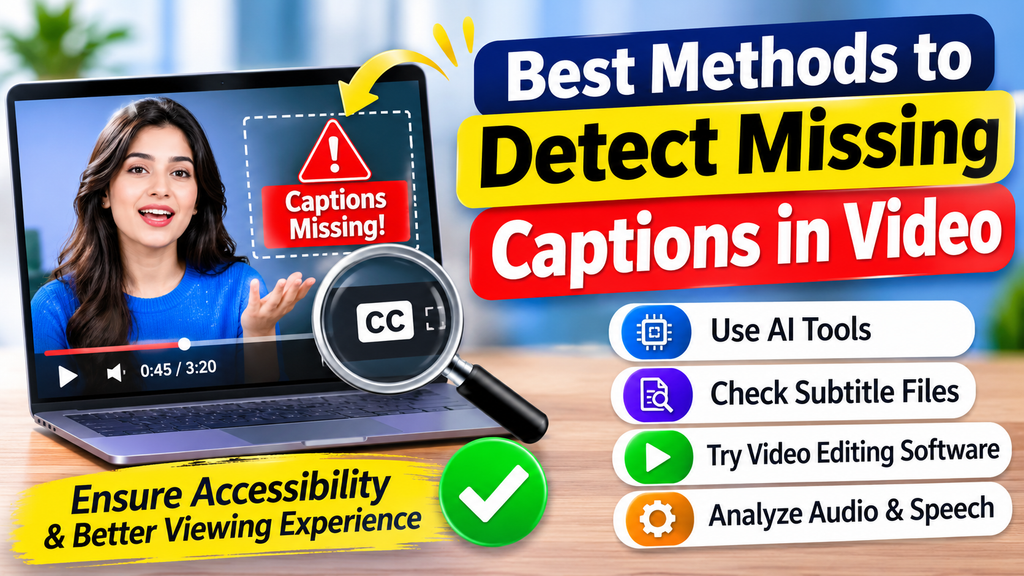
Different detection methods work for different video formats and production environments. Choosing the right approach depends on the available files, video length, and accuracy requirements.
Using AI Caption Detection Tools
AI caption detection tools automatically analyze audio and subtitle information. They can identify missing sections, compare speech with existing captions, and generate reports highlighting potential problems.
These tools are particularly useful for content creators who regularly publish videos. They reduce repetitive work and make quality control easier.
Some platforms also combine caption detection with automatic subtitle generation, allowing users to correct missing text quickly.
Checking Subtitle Files Manually
Manual subtitle inspection remains a useful method for smaller projects. Creators can open an SRT or VTT file using a text editor and examine its timestamps.
For example, an SRT file may contain the following structure:
1
00:00:01,000 –> 00:00:04,000
Welcome to our video.
2
00:00:05,000 –> 00:00:08,000
Today we will discuss AI technology.
If the video contains additional dialogue between these timestamps, the creator should investigate whether captions are missing.
Using Video Editing Software
Professional video editing applications provide subtitle timelines that make it easier to inspect caption placement.
Editors can compare the audio waveform with subtitle timing and identify sections without corresponding text. This method is useful during video production because problems can be corrected before exporting the final version.
Common Reasons Why Video Captions Go Missing
Understanding the causes of missing captions makes prevention easier.
Incorrect Subtitle Synchronization
Subtitle files sometimes contain incorrect timestamps. Captions may appear too early, too late, or disappear before the speaker finishes talking.
This problem often occurs when editors change video speed, cut scenes, or combine multiple clips without updating subtitle timing.
Damaged or Incomplete Subtitle Files
An SRT or VTT file may become corrupted during editing, uploading, or file conversion. Missing entries can also result from incomplete subtitle exports.
These problems prevent video players from displaying all expected captions.
Speech Recognition Errors
Automatic transcription systems do not always recognize every spoken word. Background noise, different accents, overlapping conversations, and unclear pronunciation can affect transcription accuracy.
As a result, certain sentences may never appear in the generated captions.
Incorrect Video Export Settings
Some editing applications allow users to export videos with or without subtitles. Incorrect settings may exclude caption tracks from the final video.
Checking export options before publishing can prevent this issue.
Key Features of an Effective AI Caption Detection System
Not every caption checker provides the same functionality. A reliable system should offer several important capabilities.
Automatic Speech-to-Text Comparison
The system should compare recognized speech with existing subtitles. This helps identify dialogue that appears in the audio but not in the caption track.
Timestamp Accuracy
Accurate timestamps are essential for identifying missing sections. The software should detect gaps and highlight captions that do not match the timing of spoken dialogue.
Multiple Video Format Support
A useful detection platform should support common video formats, including MP4, MOV, AVI, and MKV, where applicable.
It should also recognize widely used subtitle formats such as SRT and WebVTT.
Caption Gap Reports
Detailed reports help creators understand where problems occur. Ideally, the system should display missing caption sections with timestamps so editors can find and correct them quickly.
Benefits of Automatically Detecting Missing Video Captions
Automated caption detection offers practical advantages for individuals, businesses, educators, and professional video production teams.
First, it saves time. Instead of watching lengthy videos repeatedly, creators can use automated systems to identify potential caption problems.
Second, it improves accessibility. Consistent captions help people with hearing difficulties understand video content more effectively.
Third, it supports better quality control. Detecting missing subtitles before publication reduces the possibility of releasing incomplete videos.
Another advantage is production efficiency. Teams can review multiple videos using a consistent checking process, making caption quality easier to manage across large content libraries.
Best Use Cases for Missing Caption Detection
YouTube and Social Media Videos
Content creators publish videos regularly across YouTube, Instagram, Facebook, and other platforms. Automated caption checking helps identify missing subtitles before uploading content.
Online Education and Training
Educational videos often contain important explanations and instructions. Missing captions can make lessons difficult to follow.
Caption detection helps instructors maintain consistent learning materials.
Business Meetings and Presentations
Companies frequently use recorded meetings, webinars, and presentations. Checking captions ensures that important discussions remain understandable and accessible.
Marketing and Advertising Videos
Brands use captions to communicate messages to viewers who watch videos without sound. Checking subtitle coverage helps marketing teams maintain consistent messaging.
Video Streaming Platforms
Streaming services manage extensive video libraries. Automated caption quality checks can help identify incomplete subtitle tracks before content becomes available to viewers.
How to Fix Missing Captions After Detection
Identifying missing captions is only the first step. Creators must also correct the detected problems.
Start by reviewing the timestamps highlighted by the detection system. Listen to the corresponding audio and determine which dialogue is missing.
Next, use speech-to-text software to generate the missing text. Review the transcription carefully because automated systems can misunderstand names, technical terms, and unclear speech.
After correcting the text, adjust the subtitle timestamps to match the audio. Make sure captions remain visible long enough for viewers to read comfortably.
Finally, export the video again and perform another caption check. Watch the corrected sections to confirm that the subtitles appear correctly.
AI Caption Detection vs. Manual Caption Checking
Manual checking requires someone to watch the video, listen to dialogue, and compare it with available subtitles. Although this method can provide detailed results, it becomes time-consuming when working with long videos.
AI-powered caption detection automates much of this process. It can analyze audio, inspect subtitle tracks, and identify potential gaps more quickly.
However, AI is not perfect. It may misunderstand background speech, music, overlapping voices, or unusual pronunciation.
The most effective approach combines automated detection with human review. AI identifies suspicious sections, while editors verify their accuracy and make necessary corrections.
Best Practices for Preventing Missing Captions
Preventing caption problems is easier than correcting them after publication.
Always review subtitle files before exporting a video. Check whether every important spoken section has corresponding captions.
Use reliable transcription software and review automatically generated text before publishing. Avoid depending entirely on automatic speech recognition.
Keep subtitle timestamps synchronized whenever you edit or rearrange video clips. Also, verify that your export settings include the correct subtitle tracks.
Most importantly, test the final video using a media player or platform that supports captions. This final review helps identify problems that may not appear during editing.
Frequently Asked Questions (FAQs)
1. How Can I Detect Missing Captions in Video?
You can use AI caption detection software, subtitle analysis tools, or manual inspection. These methods help identify sections where spoken dialogue does not have corresponding captions.
2. Can AI Automatically Find Missing Subtitles?
Yes. AI systems can compare speech-to-text transcripts with existing subtitle tracks. They can identify potential gaps and highlight sections that require correction.
3. Which Formats Are Used for Video Captions?
Common subtitle formats include SRT and WebVTT. Some videos also use embedded caption tracks that remain inside the video container.
4. Can Missing Captions Affect Video Accessibility?
Yes. Missing captions can make videos difficult to understand for deaf and hard-of-hearing viewers. Complete and accurate captions improve accessibility and communication.
5. Is AI Caption Detection Better Than Manual Checking?
AI detection is generally faster for large video collections. However, manual review remains important for checking transcription accuracy, timing, and context.
6. Can I Fix Missing Captions Without Recreating the Entire Video?
Yes. You can edit the existing subtitle file, add missing dialogue, correct timestamps, and export the updated captions without recreating the entire video.
Conclusion
Learning how to detect missing captions in video content is important for improving accessibility, maintaining professional quality, and creating a better viewing experience. AI-powered detection systems make this process faster by analyzing audio, comparing subtitle tracks, and identifying possible caption gaps. However, automated results should always receive human review to ensure accuracy and proper synchronization. Whether you create social media content, educational lessons, business presentations, or marketing videos, regular caption quality checks help prevent incomplete subtitles. Combining AI technology with careful editing provides a practical way to deliver more accessible, consistent, and professional video content.
Read on to find if:AI Subtitle Checker for Videos