
Startups operate under constant pressure to move faster while keeping costs under control. Small teams often handle sales, customer support, marketing, finance, operations, and administration at the same time. As workloads increase, repetitive manual tasks can consume valuable hours and create unnecessary errors.
AI no-code process automation for startups offers a practical way to solve this problem. Instead of building complex software or hiring a large development team, startups can use artificial intelligence and visual automation tools to streamline everyday processes with little or no coding.
From lead management to customer onboarding, AI-powered automation can help startups save time, improve consistency, and build more efficient operations.
What Is AI No-Code Process Automation?
AI no-code process automation combines artificial intelligence with visual workflow-building technology. Users can create automated processes without writing traditional programming code.AI-Native No-Code Workflow Automation
A typical no-code automation allows a startup to define a trigger, apply AI-based logic, and perform one or more actions automatically.
For example, when a potential customer submits a form, an AI automation could analyze the request, identify the customer’s needs, add the lead to a CRM, generate a personalized response, and notify the appropriate team member.
This makes AI process automation without coding accessible to founders, marketers, operations managers, and other non-technical professionals.
Why Startups Need AI Process Automation
Startups usually have limited resources. Every hour spent copying information between applications, answering repetitive questions, or manually updating spreadsheets is an hour that could have been used for growth.
Reduce Repetitive Work
Many startup processes involve predictable activities such as sending follow-up emails, organizing customer information, creating reports, and updating records.
AI workflow automation can handle these tasks automatically, allowing employees to focus on higher-value responsibilities.
Improve Operational Efficiency
Manual processes often slow down business operations. Information may sit in an inbox for hours before someone processes it.
With AI-powered workflow automation, information can move between systems immediately. This creates faster and more consistent business processes.
Control Operating Costs
Hiring additional employees for repetitive administrative work can become expensive as a startup grows.
No-code automation allows existing teams to handle larger workloads without increasing headcount at the same rate. This makes it particularly useful for early-stage companies working with limited budgets.
Common Startup Processes to Automate
AI no-code automation can support almost every department in a growing startup.
Lead Management and Sales
Sales teams can automate lead capture, qualification, routing, and follow-ups.
An AI system can evaluate information submitted by a prospect and categorize the lead based on factors such as company size, industry, requirements, or buying intent.
Qualified prospects can then be automatically assigned to the appropriate salesperson.
Customer Onboarding
Customer onboarding often involves multiple steps, including sending welcome messages, collecting information, creating accounts, and scheduling follow-ups.
An automated workflow can coordinate these activities and make sure every new customer receives a consistent onboarding experience.
Customer Support
AI automation can categorize incoming support requests, identify common questions, and route complex issues to human agents.
Simple requests may receive automated responses, while urgent or sensitive cases can be escalated immediately.
Marketing Operations
Marketing teams can automate content workflows, campaign notifications, lead nurturing, reporting, and customer segmentation.
AI can also help analyze customer responses and determine which leads or audiences deserve additional attention.
Internal Administration
Startups can automate employee requests, document processing, notifications, approvals, and recurring reports.
These small improvements can have a significant impact when repeated hundreds of times each month.
How AI No-Code Automation Works
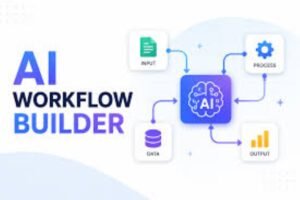
The process usually starts with a trigger.
A trigger could be a new form submission, incoming email, completed transaction, customer message, or scheduled event.
The AI then processes the available information. Depending on the workflow, it may classify text, extract important details, summarize information, generate content, or make a recommendation.
Finally, the automation performs an action. It might update a database, send an email, create a task, notify a team member, or move information into another application.
This trigger-to-decision-to-action model makes no-code AI workflow automation relatively easy to design and maintain.
Benefits Beyond Saving Time
Time savings are only one advantage of startup automation.
Better Accuracy
Automated workflows follow predefined rules consistently. This reduces mistakes caused by repetitive manual data entry.
Faster Response Times
AI systems can process information continuously instead of waiting for an employee to become available.
Faster responses can improve customer satisfaction and prevent potential leads from being lost.
Scalable Operations
A manual process that works for 20 customers may become difficult with 2,000 customers.
Automation allows startups to increase transaction volume without rebuilding every operational process from scratch.
Better Visibility
Automated workflows can create structured records of business activities. This gives founders and managers better visibility into sales, support, marketing, and operational performance.
Best Practices for Implementing AI Automation
Startups should avoid automating everything simply because automation is available.
Begin with repetitive, clearly defined processes that consume significant time. Map the existing workflow before introducing AI.
Next, identify where human judgment is genuinely necessary. AI should handle suitable repetitive tasks while employees remain responsible for decisions that require context, creativity, or accountability.
It is also important to monitor automated workflows regularly. Poorly designed processes can automate mistakes just as efficiently as they automate good decisions.
Start with one workflow, measure its results, and expand gradually.
The Future of Startup Process Automation
AI no-code process automation is becoming an important part of modern startup operations. As AI systems become better at understanding natural language, analyzing information, and making context-aware decisions, workflow creation is becoming increasingly accessible.
Founders can describe what they want a process to accomplish instead of relying entirely on developers to build it.
The biggest opportunity is not replacing people. It is removing unnecessary manual work so small teams can spend more time on product development, customer relationships, strategy, and growth.
Conclusion
AI no-code process automation for startups provides a practical approach to building faster and more efficient operations without requiring extensive programming knowledge. Startups can automate sales, customer support, onboarding, marketing, administration, and many other repetitive processes.
The strongest results come from choosing the right workflows, keeping human oversight where it matters, and improving automation based on real business results.
For startups competing with larger companies, intelligent automation can turn a small team into a highly efficient operation—and that operational advantage can become a genuine competitive






One thought on “AI No-Code Process Automation for Startups”