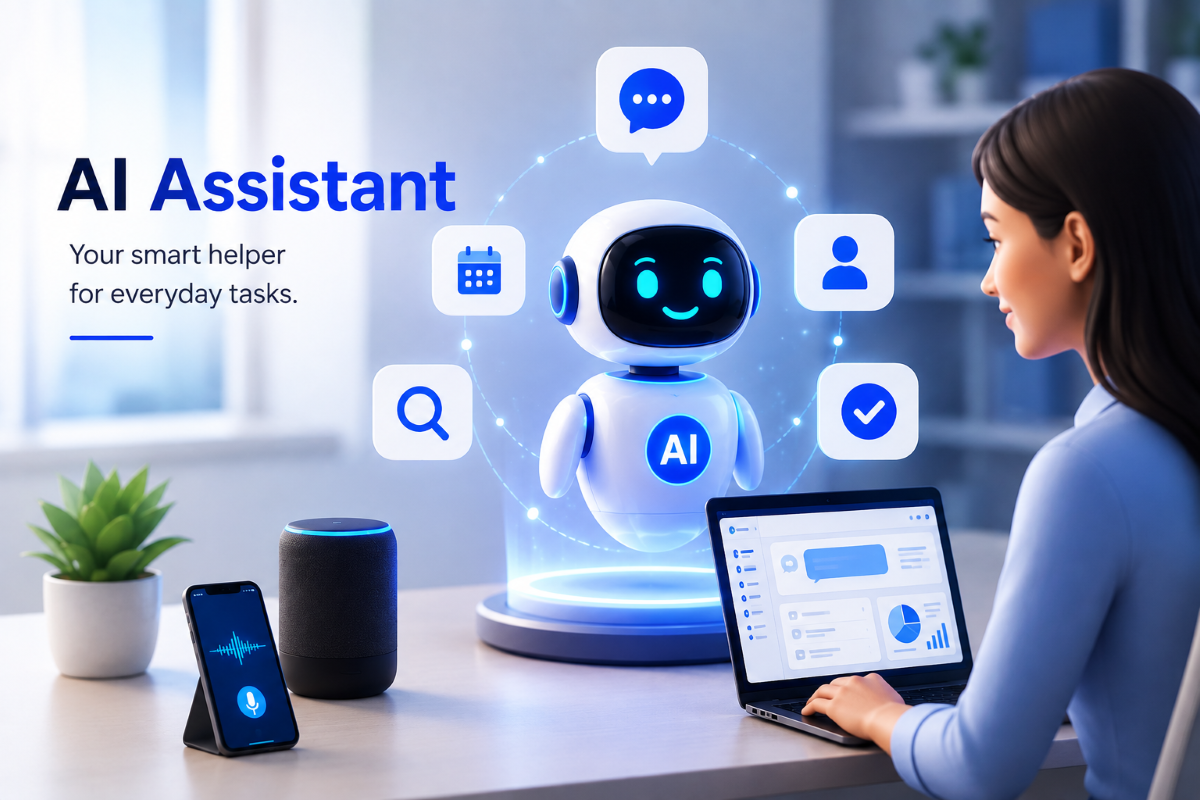
Managing databases has traditionally required technical knowledge, SQL expertise, and constant attention to data quality. As businesses generate more information than ever, database teams are looking for faster ways to search, analyze, maintain, and understand their data.
An AI Database Assistant helps solve this challenge by using artificial intelligence to interact with databases through natural language, automate repetitive tasks, generate queries, identify patterns, and provide useful insights. Instead of manually writing complex commands for every request, users can communicate with database systems in a more conversational way.
What Is an AI Database Assistant?
An AI Database Assistant is an intelligent software tool that helps users work with databases using artificial intelligence. Depending on the platform, it can connect with relational databases, cloud databases, data warehouses, or other structured data systems.
Users can ask questions such as:Ultimate Guide to AI Development Tools
- Which products generated the most revenue this month?
- Show customers who purchased more than three times.
- Find duplicate customer records.
- Compare sales between two regions.
- Create a report from last quarter’s data.
The assistant can interpret the request, generate an appropriate database query, retrieve relevant information, and present the result in an understandable format.
How AI Database Assistants Work
AI database tools typically combine natural language processing, machine learning, database connectivity, and query generation.
Natural Language to SQL
One of the most useful capabilities is natural language to SQL. A user can describe what they need without knowing SQL syntax.
For example, instead of manually writing a complicated query, a user could ask:
“Find the top 10 customers by total spending this year.”
An AI assistant can translate that request into an SQL query and return the relevant results.
This can make database analysis accessible to marketers, business owners, analysts, and other non-technical users.
Database Schema Understanding
An effective AI database assistant needs to understand the structure of the connected database. This includes tables, columns, relationships, and data types.
Schema awareness helps the AI determine which tables and fields are relevant to a particular question. Better schema understanding can also reduce incorrect queries and improve the quality of generated results.
Automated Data Analysis
AI can go beyond simply retrieving records. Some database assistants can identify trends, unusual values, correlations, or changes in business metrics.
For example, an assistant might help identify a sudden decrease in monthly orders or highlight a customer segment with unusually high activity.
Key Benefits of an AI Database Assistant
Faster Database Queries
Writing SQL manually can take time, particularly when queries involve multiple tables, joins, filters, and calculations.
An AI-powered database assistant can generate queries much faster, allowing teams to spend more time interpreting results rather than constructing commands.
Easier Access to Business Data
Traditional database systems can create a barrier for non-technical employees. Natural-language interfaces reduce that barrier.
Employees can ask questions using ordinary language instead of learning advanced SQL concepts.
Reduced Repetitive Work
Database professionals often perform repetitive tasks such as creating queries, checking records, generating reports, and troubleshooting basic SQL errors.
AI can assist with many of these activities, potentially reducing manual workload.
Improved Productivity
When employees can quickly access relevant information, decision-making workflows can become more efficient. Sales teams, finance departments, marketing professionals, and operations managers can use database insights without always depending on a technical team.
AI Database Assistant for Businesses
Businesses can use AI database assistants across many departments.
Sales and Marketing
Sales teams can analyze customer activity, purchase history, lead information, and revenue data. Marketing teams can use database insights to identify customer segments and evaluate campaign performance.
Finance
Finance departments can use AI-assisted database queries to examine transactions, expenses, revenue, and financial trends.
Customer Support
Support teams can search customer records more efficiently and identify patterns in support requests, account activity, or product usage.
Operations
Operations teams can analyze inventory, orders, suppliers, delivery information, and other operational data.
AI Database Assistant vs. Traditional Database Tools
Traditional database management still plays an essential role. Database administrators and developers need precise control over schemas, permissions, optimization, backups, and infrastructure.
An AI database assistant is better viewed as an additional productivity layer rather than a complete replacement for database professionals.
AI can help users create queries and understand information, while experienced professionals remain responsible for validating important queries and protecting critical systems.
Important Features to Look For
When choosing an AI Database Assistant, consider several important capabilities.
Database Compatibility
Check whether the tool supports your database technology, such as MySQL, PostgreSQL, SQL Server, Oracle, or cloud-based data platforms.
Natural Language Querying
Natural-language database interaction should be accurate and easy to use. The assistant should understand context rather than simply matching keywords.
SQL Generation and Explanation
A useful tool should generate SQL and explain what the query does. This makes it easier for technical users to review and modify generated commands.
Security and Access Control
Database security is critical. An AI assistant should respect existing permissions and prevent unauthorized access to sensitive information.
Data Privacy
Organizations should understand how database information is processed, stored, and protected. Sensitive business or customer data should not be exposed unnecessarily to external systems.
Challenges of AI Database Assistants
Despite their advantages, AI database assistants have limitations.
AI-generated queries can sometimes be incorrect or based on an incomplete understanding of the database schema. An apparently reasonable answer may also be misleading if the underlying data is incomplete or poorly structured.
Security is another major concern. Connecting an AI system to sensitive databases requires strong authentication, authorization, monitoring, and data governance.
For important financial, operational, or customer decisions, AI-generated results should therefore be reviewed rather than accepted blindly.
The Future of AI-Powered Database Management
AI database technology is moving toward more intelligent and proactive data management. Future systems may provide deeper automated analysis, explain database performance problems, recommend query improvements, detect unusual activity, and help organizations discover insights without requiring users to understand database architecture.
The combination of AI, SQL automation, natural language querying, and intelligent data analysis could make database technology considerably more accessible.
Conclusion
An AI Database Assistant provides a practical way to simplify database interaction and improve data accessibility. By converting natural-language requests into database queries, explaining SQL, supporting data analysis, and reducing repetitive work, these tools can help both technical and non-technical teams work more efficiently.
However, AI should complement—not replace—sound database administration, security practices, and human verification. Organizations that combine AI assistance with strong data governance can use these technologies to make their databases easier to access, analyze, and manage.





One thought on “AI Database Assistant: How Intelligent Tools Simplify Database Management”