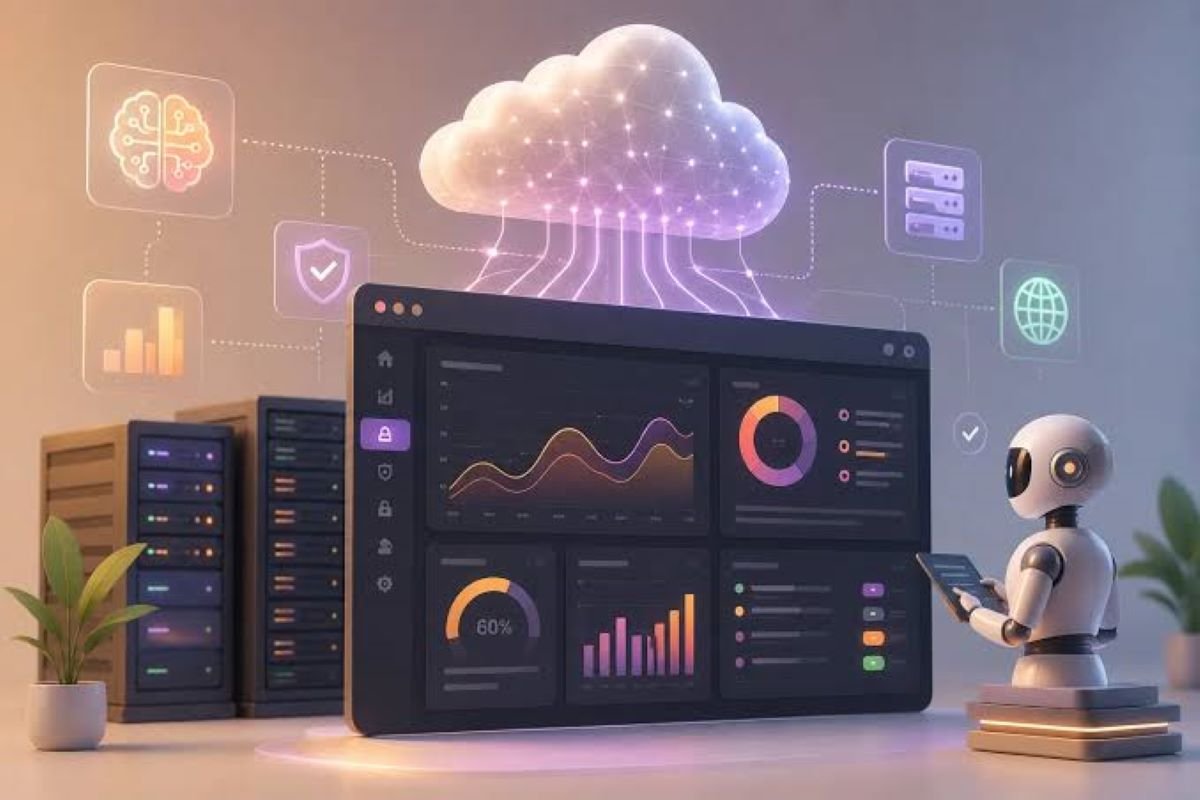
Cloud computing has transformed how businesses build and operate applications. Organizations can now deploy services across public, private, and hybrid cloud environments without maintaining all their infrastructure locally. However, this flexibility also creates a major challenge: monitoring complex cloud environments effectively.
Traditional monitoring systems rely heavily on predefined thresholds and manual analysis. As cloud infrastructure becomes more dynamic, these approaches can struggle to identify subtle problems quickly. AI cloud monitoring combines artificial intelligence, machine learning, automation, and observability to help teams understand infrastructure behavior and respond to issues more efficiently.Ultimate Guide to AI Development Tools
What Is AI Cloud Monitoring?
AI cloud monitoring is the use of artificial intelligence and machine learning to monitor cloud infrastructure, applications, workloads, networks, databases, and other cloud resources.
Instead of simply displaying metrics, AI-powered monitoring systems can analyze large volumes of operational data and identify unusual behavior.
These platforms may monitor:
- Cloud servers and virtual machines
- Containers and Kubernetes environments
- Databases
- Cloud applications
- APIs and microservices
- Network performance
- Storage resources
- CPU and memory usage
- Application logs
- Security events
The goal is to provide deeper visibility while reducing the amount of manual analysis required from IT and DevOps teams.
How AI Cloud Monitoring Works
AI cloud monitoring typically combines multiple sources of operational data.
Metrics, Logs, and Traces
Modern cloud applications produce large amounts of telemetry data. Metrics show numerical measurements such as CPU usage, memory consumption, and response time. Logs provide detailed records of system and application events, while traces help engineers follow requests across distributed services.
AI can analyze these different data sources together to identify relationships and unusual patterns.
Machine Learning for Anomaly Detection
One of the most useful capabilities of AI monitoring is anomaly detection.
Traditional monitoring might trigger an alert when CPU usage exceeds a fixed threshold. AI-based systems can instead learn normal behavior over time and identify deviations from that baseline.
For example, an application may normally experience increased traffic during business hours. An AI monitoring system can take this pattern into account rather than treating every traffic increase as an incident.
Benefits of AI Cloud Monitoring
Faster Problem Detection
Cloud environments can change rapidly. A problem that appears small initially can sometimes develop into a larger service disruption.
AI-powered monitoring can continuously analyze infrastructure activity and highlight unusual behavior, helping teams investigate potential issues earlier.
Reduced Alert Fatigue
Large cloud environments can generate thousands of alerts.
Not every alert represents a serious problem. AI can help group related events, identify patterns, and provide additional context so engineers can focus on the issues that matter most.
Improved Cloud Performance
AI monitoring can help organizations understand application and infrastructure performance.
By analyzing resource consumption and system behavior, monitoring platforms may identify potential bottlenecks or unusual performance changes.
Better Resource Management
Cloud costs can increase when resources are poorly managed.
AI-powered cloud monitoring can analyze workloads and resource usage to identify underutilized or unusually active resources. These insights can support more informed decisions about scaling and infrastructure optimization.
AI Cloud Monitoring for DevOps Teams
DevOps teams manage increasingly complex environments involving containers, APIs, microservices, CI/CD pipelines, and cloud infrastructure.
AI monitoring can provide a centralized view of these systems.
Automated Incident Analysis
When an incident occurs, engineers often need to examine logs, metrics, recent deployments, and infrastructure changes.
AI can help summarize relevant events and connect related signals. This can reduce the time required to understand what happened.
Root Cause Analysis
A single application failure may involve several underlying services.
AI-powered observability tools can correlate events across infrastructure and applications to help engineers investigate possible root causes.
However, AI-generated root-cause suggestions should be treated as investigative assistance rather than guaranteed diagnoses.
AI Cloud Monitoring and Predictive Analytics
Another important application is predictive monitoring.
Instead of only identifying current problems, machine learning models can analyze historical information to identify patterns that may indicate future issues.
For example, continuously increasing memory usage could indicate a potential application problem. A monitoring system may highlight the trend before the application reaches a critical resource limit.
Predictive analytics can therefore support more proactive infrastructure management.
Multi-Cloud and Hybrid Cloud Monitoring
Many organizations use more than one cloud provider or combine cloud infrastructure with on-premises systems.
This creates additional monitoring complexity.
AI-powered cloud monitoring can help bring information from different environments into a unified operational view.
A centralized approach can make it easier to compare performance, identify cross-environment issues, and understand application dependencies.
Security Monitoring in the Cloud
Cloud monitoring can also contribute to security operations.
AI systems can analyze authentication events, network activity, access patterns, and other operational signals to identify unusual behavior.
For example, unexpected access patterns or unusual activity from a normally inactive account may deserve further investigation.
AI should complement established security controls rather than replace authentication, authorization, encryption, and other fundamental security practices.
Challenges of AI Cloud Monitoring
Despite its benefits, AI monitoring has limitations.
False Positives
AI systems can sometimes identify normal activity as unusual. Poorly configured models can generate unnecessary alerts and create additional work for engineering teams.
Data Quality
AI monitoring depends heavily on reliable telemetry. Missing logs, inconsistent metrics, and incomplete system visibility can reduce the quality of its analysis.
Privacy and Security
Cloud monitoring systems may process sensitive operational or business information. Organizations need appropriate access controls, data protection policies, and retention practices.
Complexity
Implementing AI-powered observability across large cloud environments can require significant technical planning. Teams need to understand their monitoring requirements before introducing additional tools.
Choosing an AI Cloud Monitoring Solution
When evaluating an AI cloud monitoring platform, consider its integrations, observability capabilities, alert management, security features, scalability, and automation options.
It should support the cloud services and infrastructure your organization actually uses.
Look for tools that provide understandable explanations rather than simply generating unexplained alerts. Human-readable insights can make AI recommendations much easier for engineers to validate.
The Future of AI Cloud Monitoring
Cloud infrastructure will continue becoming more distributed and dynamic. As applications adopt microservices, containers, serverless architectures, and multi-cloud deployments, monitoring requirements will become increasingly complex.
AI can help organizations process this growing volume of operational information.
Future AI cloud monitoring tools are likely to provide more automated correlation, intelligent incident assistance, predictive analysis, and infrastructure optimization.
The most useful systems will not simply produce more alerts. They will help teams understand what is happening, why it matters, and what should be investigated next.
Conclusion
AI cloud monitoring brings artificial intelligence into the management of modern cloud environments. By analyzing metrics, logs, traces, and infrastructure behavior, AI-powered monitoring can help teams detect anomalies, reduce alert noise, investigate incidents, and improve cloud performance.
However, AI monitoring is most effective when combined with strong observability practices, reliable data, security controls, and human expertise. Organizations that use AI as an intelligent monitoring and analysis layer can gain better visibility into increasingly complex cloud infrastructure while reducing unnecessary manual effort.





One thought on “AI Cloud Monitoring: A Smarter Approach to Modern Cloud Infrastructure”