Every founder knows the feeling. The month ends, and instead of planning the next sprint, you’re pulling numbers from Stripe, QuickBooks, HubSpot, and a spreadsheet nobody fully trusts. Hours later, you’re still polishing an investor update.
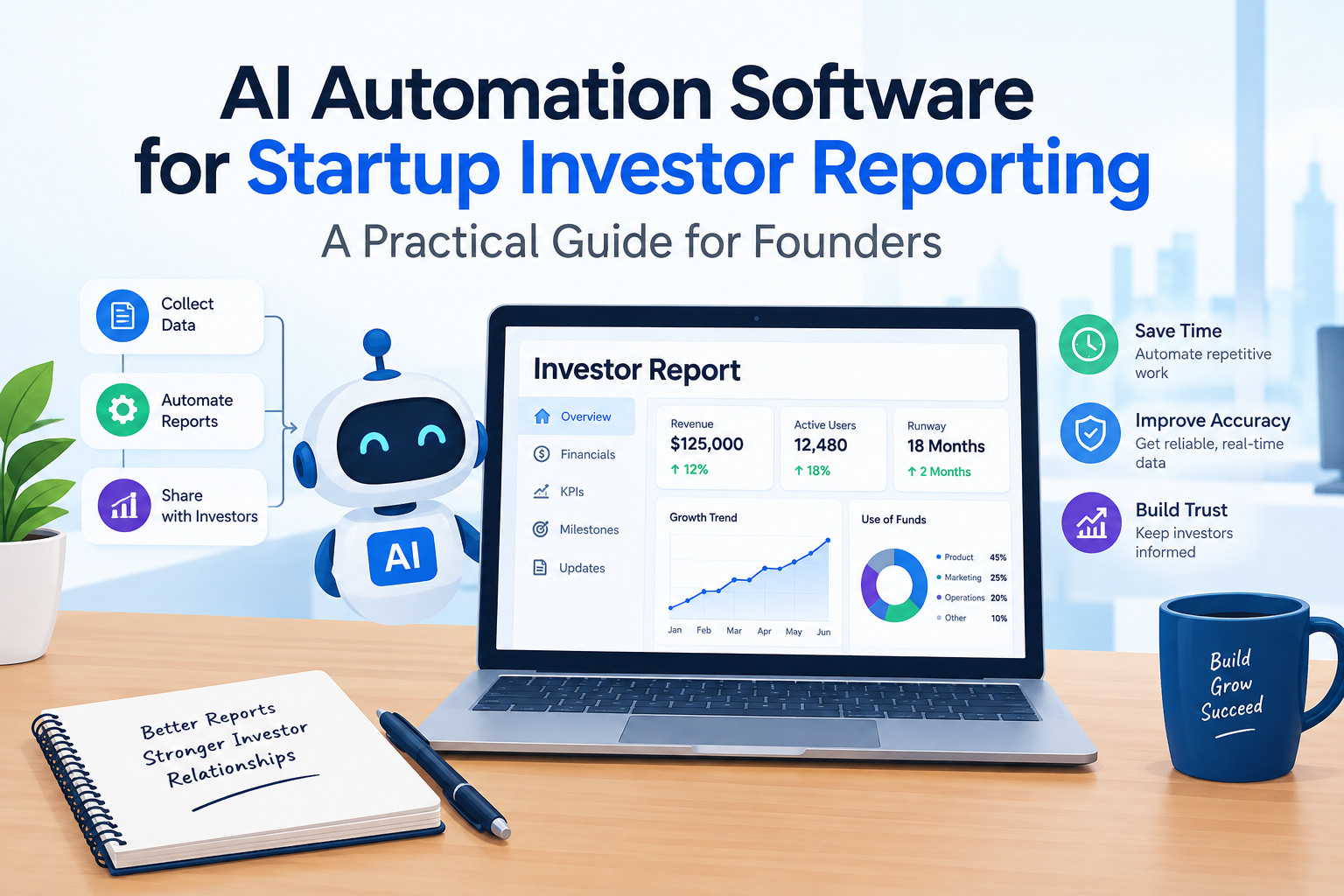
AI automation software for startup investor reporting is changing that routine. Instead of assembling reports by hand, founders can now connect their tools, let algorithms do the heavy lifting, and spend their time on what investors actually care about: decisions.
This guide covers what these tools do, why they matter, and how to choose one that fits your stage.
Related Post:AI workflow tools for startup sales pipeline automation
Why Investor Reporting Is Harder Than It Looks
Investors don’t expect perfection, but they do expect consistency. A clear, regular update builds trust. A late or muddled one raises quiet doubts.
The trouble is that the data lives everywhere. Revenue sits in your billing platform, expenses in accounting software, pipeline in your CRM, and headcount in an HR system. Reconciling them manually invites errors, and errors in front of investors are costly.
The Hidden Cost of Manual Reporting
Most early-stage teams underestimate the time involved. A monthly update can easily swallow six to ten hours once you count data pulls, formatting, commentary, and review.
Multiply that across twelve months, and you’ve lost several working weeks a year. For a small team, that’s a real opportunity cost.
What AI Automation Software Actually Does
The phrase “AI automation” gets thrown around loosely, so it helps to be specific. Good platforms handle a few distinct jobs.
Automated Data Collection and Consolidation
The foundation is integration. The software connects to your financial, sales, and product systems through APIs and pulls fresh data on a schedule. No more copy-pasting between tabs.
Once the data is in one place, the tool standardizes definitions so that metrics like monthly recurring revenue (MRR) or customer churn mean the same thing every time.
Real-Time KPI Dashboards
Instead of a static PDF, many platforms offer live dashboards. Investors can see burn rate, runway, growth trends, and cash position without waiting for your next email.
That transparency tends to reduce ad hoc questions, since the answers are already visible.
AI-Generated Narrative and Insights
This is where the “AI” earns its name. Modern tools use language models to draft commentary: why revenue dipped, what drove a spike in signups, or how burn compares to last quarter.
You still review and edit the story. But starting with a solid draft beats staring at a blank page.
Anomaly Detection and Forecasting
Machine learning can flag unusual movements, such as a sudden jump in refunds or an expense category creeping upward. It can also project runway under different scenarios, helping you brief investors before they ask.
Key Benefits for Startups
The advantages go beyond saving time.
- Accuracy: Fewer manual steps means fewer transcription errors.
- Consistency: Investors see the same metrics, defined the same way, every period.
- Speed: Reports that took a day can be ready in minutes.
- Credibility: Timely, polished updates signal operational maturity, which matters during fundraising.
- Focus: Founders reclaim time for strategy, hiring, and customers.
Features to Look For When Choosing a Platform
Not every tool suits every company. Before committing, weigh these factors.
Integration Depth
Check that the software connects to the systems you already use. Native integrations with accounting, payments, CRM, and payroll tools are far more reliable than manual CSV uploads.
Customization and Branding
Your update should sound like you. Look for editable templates, custom metrics, and the ability to add your own commentary.
Investor Access and Permissions
Some platforms let you share reports with different stakeholders at different levels of detail. A lead investor may want granular data, while a small angel only needs highlights.
Security and Compliance
You’re handling sensitive financial information. Prioritize encryption, role-based access, audit logs, and clear data-handling policies. Ask vendors about SOC 2 compliance if it matters to your investors.
Pricing That Scales
Early-stage budgets are tight. Compare pricing tiers, and check whether costs jump sharply as your data volume or user count grows.
Common Pitfalls to Avoid
Automation is powerful, but it isn’t a substitute for judgment.
Trusting outputs blindly. AI-drafted commentary can miss context. Always read before sending.
Over-reporting. More metrics don’t mean better updates. Choose the five to eight numbers that tell your story.
Skipping data hygiene. Automation amplifies whatever is in your systems. If your bookkeeping is messy, your reports will be too. Clean the foundation first.
How to Get Started
You don’t need to overhaul everything at once. A simple rollout works well.
- Define your core metrics. Agree internally on how you calculate MRR, churn, burn, and runway.
- Connect your primary data sources. Start with finance and revenue systems.
- Run a parallel cycle. Produce one report manually and one with the tool, then compare.
- Refine the template. Adjust the layout and commentary style based on investor feedback.
- Set a cadence. Monthly is standard for most seed and Series A companies, with quarterly deep dives.
The Bigger Picture
Investor reporting isn’t just an obligation. Done well, it strengthens relationships, surfaces problems early, and makes future fundraising smoother. Investors remember the founders who communicated clearly when times were hard.
AI automation software won’t write your strategy for you. What it can do is remove the tedious parts, so your updates are accurate, timely, and genuinely useful. For a lean startup team, that’s a trade worth making.






One thought on “AI Automation Software for Startup Investor Reporting: A Practical Guide for Founders”