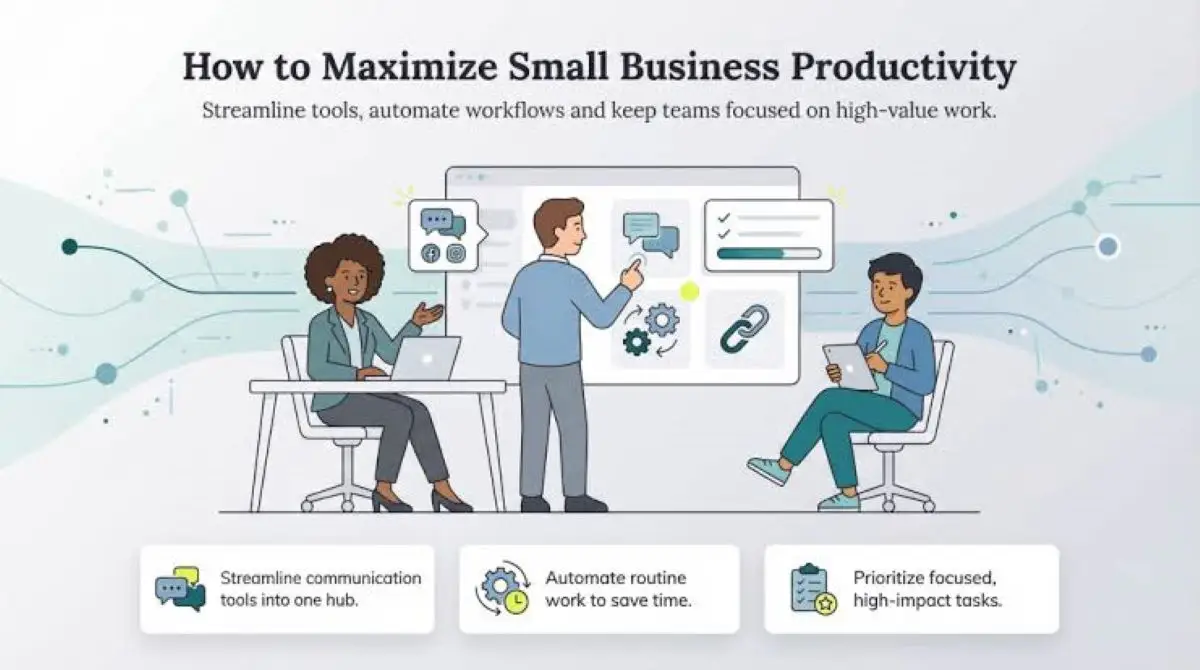
Small businesses often face the challenge of managing limited resources while meeting growing customer expectations. Owners and employees must handle multiple responsibilities, from communication and marketing to sales, accounting, and customer service. Without the right systems, these tasks can consume valuable time and reduce overall productivity.
Fortunately, improving business efficiency does not always require expensive software or complicated technology. Simple tech solutions for small business productivity can help teams organize their work, automate repetitive tasks, and communicate more effectively.
By choosing practical digital tools that address everyday challenges, small businesses can save time, reduce operational costs, and create a more productive working environment.
Why Small Businesses Need Simple Technology Solutions
MUST READ:Affordable technology solutions for small businesses
Productivity is not simply about completing more tasks. It is about using available time and resources effectively to achieve meaningful business results.
Traditional processes, such as manually tracking orders, organizing paperwork, or sending individual reminders, can slow down daily operations. These activities may seem manageable at first, but they become difficult as a business grows.
Simple business technology solutions help eliminate unnecessary work and make important information easier to access.
Reduce Time Spent on Repetitive Tasks
Many daily business activities follow predictable patterns. Sending appointment reminders, creating invoices, updating customer records, and organizing files are common examples.
Digital tools can handle many of these tasks automatically. Employees can then focus on customer relationships, sales opportunities, and other activities that require human judgment.
Improve Organization and Accountability
When information is scattered across emails, spreadsheets, and paper documents, employees may struggle to find what they need.
Centralized digital systems help businesses organize information, assign responsibilities, and monitor progress. This improves accountability and reduces the chances of missed deadlines.
7 Simple Tech Solutions That Improve Small Business Productivity
Small businesses do not need to adopt every available technology. The most effective approach is to identify common problems and choose tools that solve them without creating unnecessary complexity.
1. Cloud-Based File Storage and Document Sharing
Cloud storage is one of the simplest ways to improve business organization. Instead of keeping important documents on individual computers, businesses can store files in a centralized online location.
Cloud-based platforms allow authorized employees to access documents from different devices and locations.
They also support collaboration by making it easier to share files, manage permissions, and maintain updated versions of important documents.
Productivity benefit: Employees spend less time searching for files, sending attachments, and managing duplicate documents.
2. Project Management and Task Tracking Software
Managing several projects through emails and informal conversations can quickly become confusing.
Project management tools provide a clear overview of tasks, deadlines, priorities, and responsibilities. Small teams can use digital task boards or shared to-do lists to coordinate their work.
For example, a marketing team can organize content creation, review, and publishing within a single workspace.
These systems help business owners identify delays before they affect important deadlines.
Productivity benefit: Better task visibility, clearer responsibilities, and more consistent project delivery.
3. Business Communication and Collaboration Tools
Effective communication is essential for productive teamwork. However, long email conversations and unclear instructions can waste time.
Business communication platforms provide organized channels for team discussions, file sharing, and quick updates.
Video conferencing tools also make it easier to conduct meetings with remote employees, clients, and business partners.
Small businesses should establish simple communication rules, such as using email for formal communication and team messaging for quick questions.
Productivity benefit: Faster information sharing and fewer unnecessary meetings.
4. Accounting and Invoicing Software
Financial administration is another area where technology can save valuable time.
Basic accounting software helps businesses create invoices, record expenses, monitor payments, and organize financial information.
Many platforms also support recurring invoices and automatic payment reminders, reducing the need for manual follow-ups.
Accurate digital records make it easier to review business performance and prepare financial reports.
Productivity benefit: Less administrative work, better financial visibility, and fewer avoidable bookkeeping errors.
5. Customer Relationship Management (CRM) Systems
Customer relationship management software helps businesses organize customer information, sales activities, and communication history.
A simple CRM system can record customer inquiries, track potential sales, and remind employees when to follow up.
For small businesses that receive inquiries through multiple channels, a centralized customer database can prevent important opportunities from being overlooked.
Productivity benefit: More organized sales processes and stronger customer follow-up.
6. Automation Tools for Everyday Workflows
Workflow automation connects different digital tools to perform routine activities with minimal manual effort.
For example, a business can automatically send a confirmation email when a customer completes a form. Another workflow might create a task whenever a new sales inquiry arrives.
These small improvements can save considerable time when repeated across many transactions.
Businesses should begin with simple, low-risk workflows before introducing more advanced automation.
Productivity benefit: Reduced manual data entry, fewer repetitive actions, and smoother daily operations.
7. AI-Powered Tools for Writing and Research
Artificial intelligence tools can support everyday business activities, including drafting emails, summarizing documents, preparing content outlines, and organizing research.
Small business owners can use AI assistants to generate initial drafts, brainstorm marketing ideas, or simplify lengthy information.
However, AI-generated content should always be reviewed for accuracy, tone, and relevance before publication or distribution.
Sensitive customer information should not be entered into AI tools unless their privacy and security arrangements are appropriate.
Productivity benefit: Faster first drafts, quicker research, and additional support for employees handling multiple responsibilities.
How to Choose the Right Technology for Your Business
The best technology is not necessarily the one with the most features. It is the one that solves a real problem and fits your team’s working habits.
Before investing in new software, consider the following factors.
Identify Your Biggest Productivity Challenges
Start by reviewing your daily operations. Determine which activities take the most time, create frequent errors, or cause delays.
If employees spend hours organizing customer information, a CRM may be more useful than an advanced project management platform.
If invoices are frequently delayed, accounting software could provide a more immediate improvement.
Consider Cost and Ease of Use
Small businesses should evaluate subscription fees, setup requirements, training time, and ongoing maintenance.
Free or affordable plans can be suitable for small teams, but check their storage limits, user restrictions, and essential features before committing.
Choose software that employees can learn quickly. Complicated systems may create additional work instead of improving productivity.
Prioritize Security and Data Protection
Business technology often involves customer details, financial records, and internal documents.
Use strong passwords, enable multifactor authentication, and regularly review access permissions. Keep important information backed up and establish clear rules for handling sensitive data.
Security should be considered from the beginning rather than added after a problem occurs.
Practical Steps to Implement Productivity Technology
Adopting new software works best when the process is gradual and organized.
- Start with one problem. Select a repetitive task or operational difficulty that affects your business every week.
- Choose one suitable tool. Compare a few options and select the simplest solution that meets your requirements.
- Test it with a small team. Introduce the software to a limited number of employees and gather feedback.
- Create a simple workflow. Explain how the tool should be used and who is responsible for maintaining it.
- Measure the results. Compare the time, errors, or costs involved before and after implementation.
This approach helps businesses avoid unnecessary spending and makes technology adoption easier for employees.
Common Mistakes to Avoid
One common mistake is purchasing too many tools at once. Multiple platforms with overlapping features can create confusion, increase costs, and require employees to switch between systems.
Another mistake is automating an inefficient process without improving it first. Technology can make a poor workflow faster, but it cannot automatically make that workflow effective.
Small businesses should also avoid choosing software based entirely on popularity. A widely used platform may not suit a company’s budget, team size, or operational needs.
The goal is to build a practical digital environment where tools work together and support the business rather than complicate it.
Conclusion
Simple tech solutions for small business productivity can make a meaningful difference in how companies manage their daily operations. Cloud storage, task management software, accounting platforms, CRM systems, workflow automation, and AI assistants all offer opportunities to reduce administrative work and improve efficiency.
However, successful digital transformation does not depend on adopting the largest number of tools. It depends on selecting the right technology, implementing it carefully, and measuring its impact.
Small businesses that take a practical approach to technology can build more organized workflows, support better teamwork, and create a stronger foundation for sustainable growth.
The smartest place to begin is with one everyday problem. Solve it with a simple digital solution, measure the improvement, and expand your technology strategy as your business needs evolve.








One thought on “Simple Tech Solutions for Small Business Productivity”