

Technology has become essential for modern businesses, but small companies often operate with limited budgets. Investing in expensive software, advanced hardware, and large IT systems may not be realistic for a growing business.
Fortunately, affordable technology solutions for small businesses have made it easier to improve productivity, communication, customer service, and daily operations without creating unnecessary expenses.
The goal is not to purchase the most advanced technology available. It is to select practical tools that solve real business problems and provide measurable value.
Why Affordable Technology Matters
Small businesses compete with larger organizations that often have bigger teams and technology budgets. Affordable digital tools can help close that gap.
Cloud software, automation platforms, online accounting systems, communication apps, and cybersecurity tools allow small companies to access capabilities that were once available mainly to large enterprises.
The right technology can reduce repetitive work, minimize errors, improve collaboration, and help employees focus on higher-value responsibilities.
1. Cloud-Based Business Software
Cloud computing is one of the most useful affordable technology options for small companies.
Instead of purchasing and maintaining expensive servers, businesses can use cloud-based applications for file storage, document management, collaboration, accounting, and customer information.
Benefits of Cloud Technology
Cloud solutions allow employees to access business information from computers, tablets, and smartphones. This can be particularly useful for remote teams and businesses with employees working from different locations.
Many providers also offer free plans or affordable monthly subscriptions, allowing companies to start small and upgrade when their needs increase.
2. Affordable Project Management Tools
Managing business tasks through email and spreadsheets can become difficult as the number of projects increases.
Affordable project management software provides a central location for assigning tasks, setting deadlines, tracking progress, and sharing project information.
Improving Team Productivity
A small team can use project management technology to organize marketing campaigns, customer projects, content production, product development, and administrative tasks.
Better organization reduces missed deadlines and makes it easier for managers to understand what employees are working on.
3. Low-Cost Communication Solutions
Effective communication is critical for small businesses, especially when employees work remotely or across multiple locations.
Affordable communication platforms can combine instant messaging, video meetings, file sharing, and team discussions.
Instead of relying on long email chains, employees can communicate quickly through dedicated channels or group conversations.
Video conferencing can also reduce travel costs while allowing businesses to maintain regular contact with customers, suppliers, and remote employees.
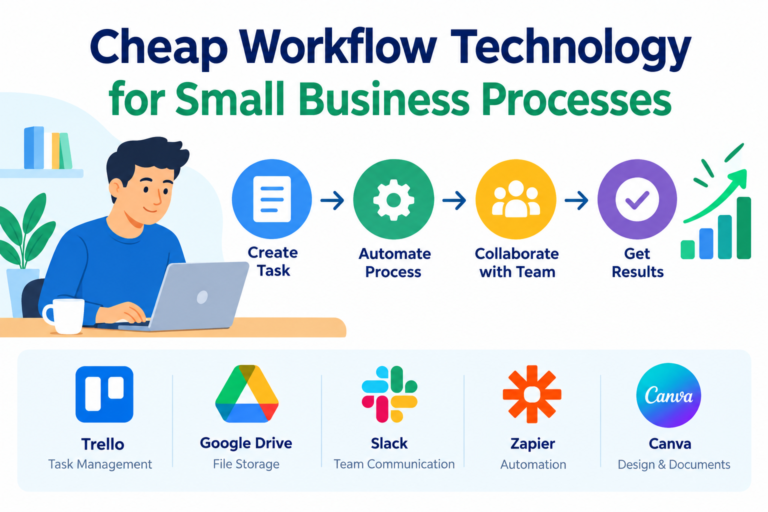
4. Business Process Automation
Automation is another powerful way to reduce operating costs.
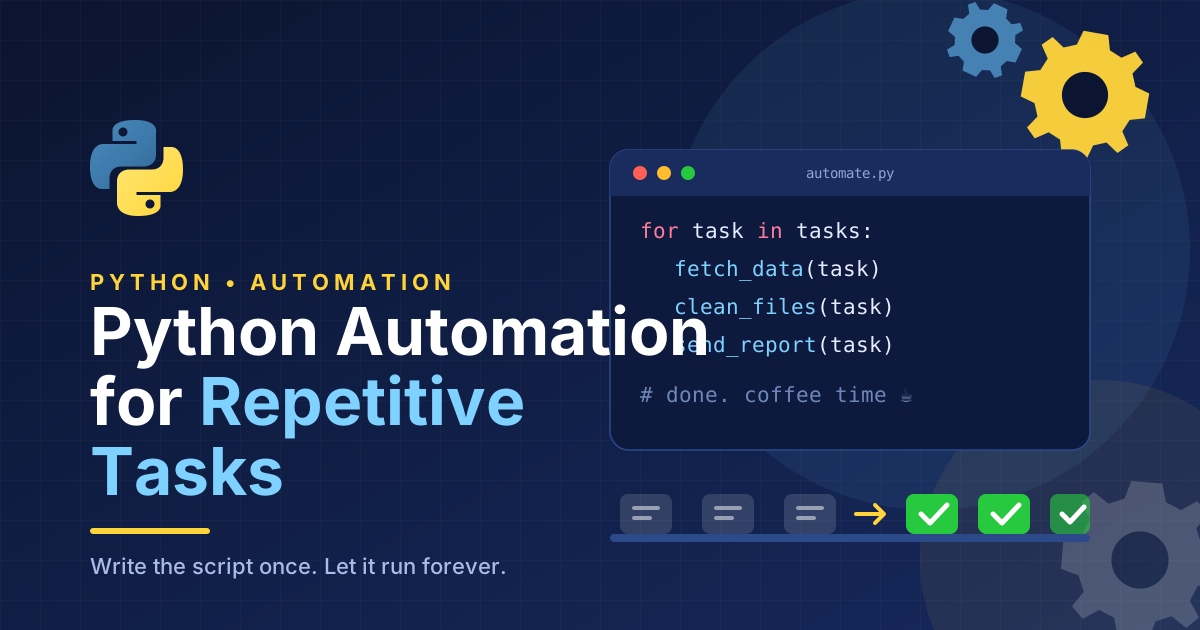
Small businesses often spend hours performing repetitive tasks such as sending emails, updating spreadsheets, entering customer information, creating notifications, and organizing leads.
Simple Tasks to Automate
Businesses can automate:
- Customer follow-up emails
- Appointment reminders
- Lead notifications
- Data transfers between applications
- Invoice reminders
- Internal task assignments
- Basic reporting
- Social media publishing
Affordable workflow automation tools can connect different applications and move information automatically.
This saves employee time while reducing the possibility of manual errors.
5. Affordable CRM Software
Customer relationship management software helps businesses organize customer and prospect information.
Without a CRM, customer details may be spread across spreadsheets, emails, notebooks, and messaging applications. This makes follow-ups difficult and can cause valuable leads to be forgotten.
An affordable CRM can centralize contact information, sales opportunities, customer interactions, and follow-up tasks.
Why CRM Technology Is Valuable
A small sales team can use CRM software to understand which leads require attention and where prospects are in the sales process.
Many CRM platforms offer free or low-cost plans, making them accessible to startups, freelancers, agencies, and growing companies.
6. Online Accounting and Payment Tools
Financial management is another area where technology can reduce administrative work.
Affordable accounting software can help small businesses manage invoices, expenses, payments, financial records, and basic reporting.
Online invoicing can also speed up payment collection and provide customers with professional-looking invoices.
Before choosing an accounting platform, businesses should consider pricing, features, integrations, data security, and compatibility with their local financial requirements.
7. Budget-Friendly Cybersecurity
Cybersecurity should be part of every small business technology strategy.
A company does not need a large IT department to implement basic security measures. Affordable cybersecurity solutions combined with good internal practices can significantly improve protection.
Businesses should use strong and unique passwords, enable multi-factor authentication, update software regularly, restrict access to sensitive information, and maintain reliable backups.
Employee Security Training
Technology alone cannot eliminate every security risk.
Employees should understand common threats such as phishing emails, suspicious attachments, fake login pages, and social engineering attempts.
Even basic cybersecurity awareness can prevent costly mistakes.
8. Digital Marketing Technology
Affordable marketing technology allows small businesses to promote their products and services without maintaining a large marketing department.
Businesses can use low-cost tools for social media scheduling, email campaigns, website analytics, graphic design, content planning, and search engine optimization.
These tools can help companies maintain a consistent online presence while reducing repetitive marketing tasks.
However, businesses should avoid subscribing to numerous platforms simply because they appear useful. Every marketing tool should have a clear purpose.
9. Cloud Backup and Data Storage
Business data is one of a company’s most valuable assets.
Documents, customer records, invoices, contracts, product information, and marketing files can be difficult or impossible to recover after hardware failure, accidental deletion, or a security incident.
Affordable cloud storage and backup services provide a practical way to protect important files.
Businesses should establish clear backup procedures and limit access to sensitive information.
10. How to Choose Affordable Business Technology
Choosing technology based only on price can be a mistake. A free tool may become expensive if it wastes employee time or lacks essential features.
Identify the Business Problem
Start by identifying what needs improvement. Is your team spending too much time on administration? Are customer inquiries being missed? Are employees struggling to manage projects?
The answer should guide your technology purchase.
Check Total Cost
Consider more than the monthly subscription. Look at setup costs, employee training, integrations, upgrades, support, and potential switching costs.
Prioritize Ease of Use
Technology should make work easier, not create another complicated process.
Choose software employees can understand quickly and use consistently.
Consider Scalability
A growing company should avoid solutions that become unusable after gaining a few additional customers or employees.
Scalable technology allows businesses to increase functionality without rebuilding their entire digital infrastructure.
Creating a Cost-Effective Technology Strategy
The best approach is to build a small, practical technology stack rather than purchasing dozens of applications.
Start with essential areas such as communication, cloud storage, accounting, customer management, cybersecurity, and automation.
Review subscriptions regularly. If a tool is rarely used or does not produce meaningful value, eliminate it.
Technology should reduce costs and improve efficiency—not become another unnecessary expense.
Final Thoughts
Affordable technology solutions for small businesses can provide significant advantages without requiring a large investment. Cloud software, automation platforms, CRM systems, accounting tools, communication solutions, cybersecurity services, and digital marketing technology can help small companies operate more efficiently.
The smartest strategy is to focus on business needs first and technology second. Choose tools that save time, reduce errors, improve customer experiences, and support long-term growth.
A small business does not need an expensive technology stack to become more efficient. It needs the right affordable technology solutions, implemented carefully and evaluated regularly.







One thought on “Affordable Technology Solutions for Small Businesses”