Learning programming can seem difficult when you are starting from zero. With the right language and a simple learning path, however, programming becomes much easier. Python programming for absolute beginners is a popular starting point because Python uses clear, readable syntax and can be used for many different types of projects.
Whether you want to build websites, automate repetitive tasks, analyze data, or explore artificial intelligence, learning Python can give you a strong foundation for your technology career.
What Is Python Programming?
Python is a high-level, general-purpose programming language created to make software development easier to understand and write. Its simple syntax allows beginners to focus on learning programming concepts instead of dealing with complicated code structures.
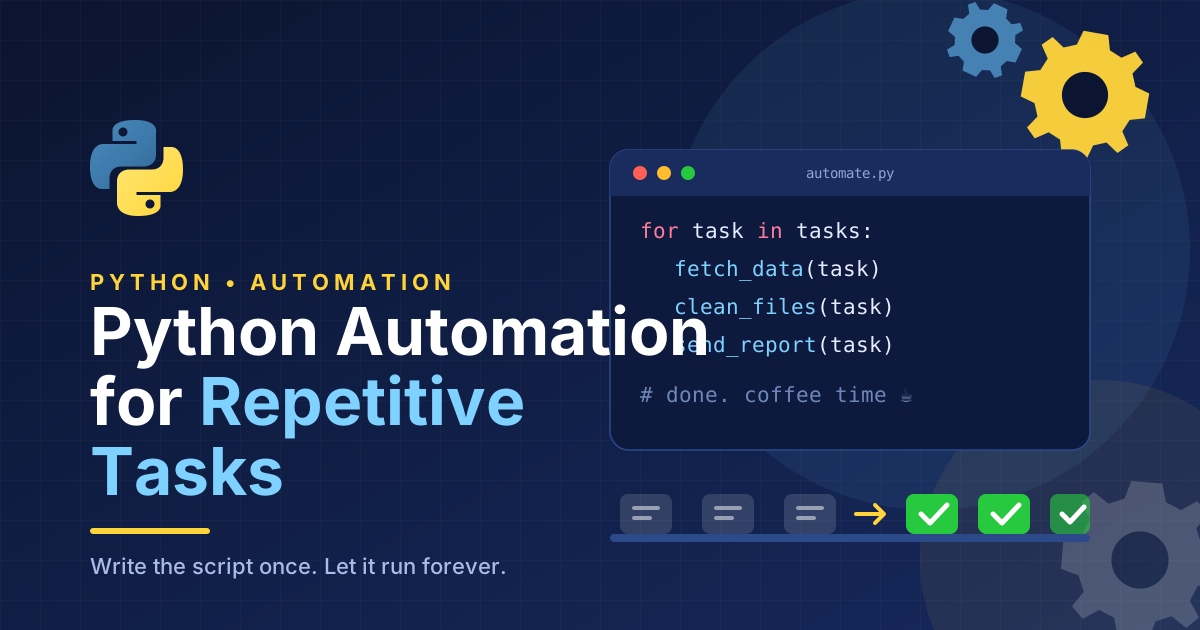
Python is widely used in web development, data science, machine learning, automation, cybersecurity, software development, and scripting.
One of Python’s biggest advantages is its large ecosystem of libraries and frameworks. These tools allow developers to create useful applications without building every feature from scratch.
Why Should Beginners Learn Python?
Python is often recommended for people who have never programmed before. Its code is relatively easy to read, which makes it simpler to understand what a program is doing.
Another benefit is the huge amount of educational material available online. Beginners can find tutorials, documentation, exercises, communities, and practical projects to support their learning.
Python also has excellent career potential. Companies use it for automation, backend development, data analysis, artificial intelligence, and other technical tasks.
Simple and Readable Syntax
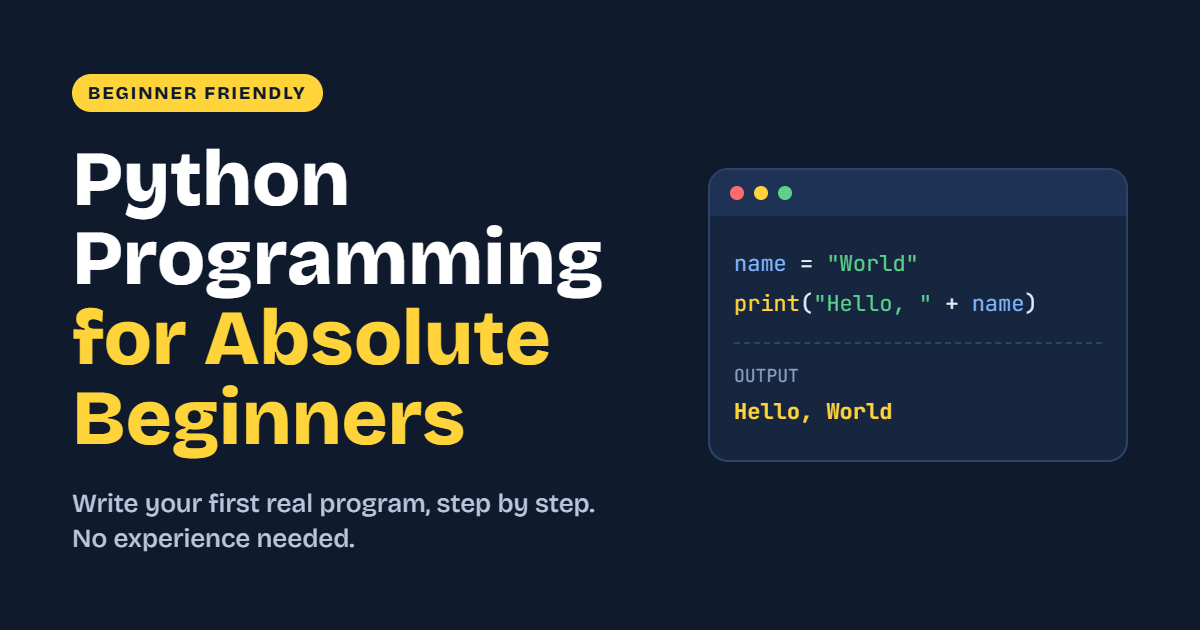
Consider this basic Python example:Python Programming Guide for Beginners
name = “Alex”
print(“Hello”, name)
This program stores a name in a variable and displays a message. Even without previous programming experience, you can probably understand what the code is doing.
That readability makes Python programming a practical choice for absolute beginners.
How Does Python Work?
Python programs consist of instructions that tell a computer what to do. You write these instructions in a Python file, usually with a .py extension, and then run the program using a Python interpreter.
The interpreter reads the code and executes it.
Before writing larger programs, beginners should understand several fundamental programming concepts.
Variables
Variables store information that your program can use later.
age = 25
name = “Sarah”
Here, age contains a number while name contains text.
Data Types
Python supports different types of data. Common examples include:
- String: Text such as “Hello”
- Integer: Whole numbers such as 25
- Float: Decimal numbers such as 10.5
- Boolean: True or False
- List: A collection of multiple values
Understanding data types is an important part of learning Python because different types can be used in different ways.
Important Python Concepts for Beginners
Once you understand variables and data types, you can start learning the building blocks of programming.
Conditional Statements
Conditional statements allow your program to make decisions.
age = 18
if age >= 18:
print(“You are an adult”)
The program checks whether the condition is true before displaying the message.
Loops
Loops are useful when you need to repeat an action multiple times.
for number in range(5):
print(number)
Instead of writing the same instruction repeatedly, a loop handles the repetition automatically.
Functions
Functions organize code into reusable sections.
def greet(name):
print(“Hello”, name)
greet(“Alex”)
Learning how to create and use functions will help you write cleaner and more organized Python programs.
How to Start Learning Python
The best way to learn Python programming is through consistent practice. Reading tutorials alone is not enough. You need to write code and experiment with it.
Start by learning basic syntax, variables, data types, operators, conditions, loops, and functions. After that, move toward lists, dictionaries, file handling, error handling, and object-oriented programming.
Do not try to learn everything at once. Programming becomes easier when you build knowledge gradually.
Practice With Small Projects
Small projects are one of the most effective ways to learn Python for beginners.
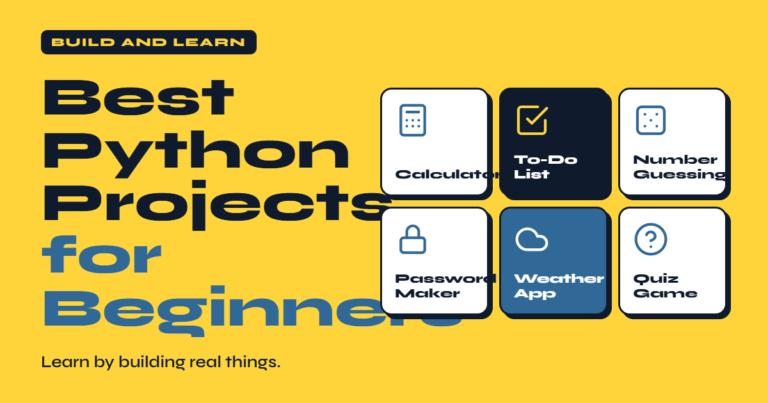
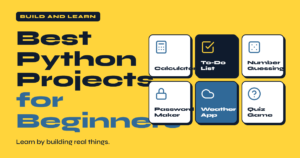
You could create a simple calculator, number guessing game, to-do list, password generator, expense tracker, or basic quiz application.
These projects help you turn theoretical concepts into practical programming skills.
Common Mistakes Beginners Should Avoid
Many new programmers make the mistake of trying to memorize every Python command. This is unnecessary.
Professional developers regularly use documentation and search for syntax when they need it. The important skill is understanding programming logic and knowing how to solve problems.
Another common mistake is avoiding errors. Errors are a normal part of programming. Instead of becoming frustrated, read the error message carefully and identify where the problem occurred.
You should also avoid jumping between too many programming languages at the beginning. Focus on Python until you understand fundamental programming concepts.
What Can You Build With Python?
Python is much more than a beginner-friendly language. After developing your skills, you can use it for many real-world applications.
Python can be used for:
- Web applications
- Data analysis
- Machine learning
- Artificial intelligence
- Automation scripts
- Desktop applications
- Cybersecurity tools
- Web scraping
- Scientific computing
- Backend development
Its flexibility means that the skills you develop as a beginner can eventually lead to more advanced programming projects.
Final Thoughts
Python programming for absolute beginners provides a practical introduction to the world of software development. Its readable syntax, extensive libraries, and broad range of applications make it an excellent language for people starting their programming journey.
The key is to practice consistently. Learn one concept, write code using it, make mistakes, fix those mistakes, and then move to the next concept.
You do not need to become an expert overnight. Start with simple Python programs and gradually build more complex projects. With patience and regular practice, Python can become a powerful foundation for your programming and technology career.