Artificial intelligence is no longer limited to research labs and experimental projects. Businesses now use AI for customer support, fraud detection, automation, forecasting, content generation, cybersecurity, and data analysis. However, building an AI model is only one part of the process. The real challenge begins when that model needs to operate reliably in a production environment.
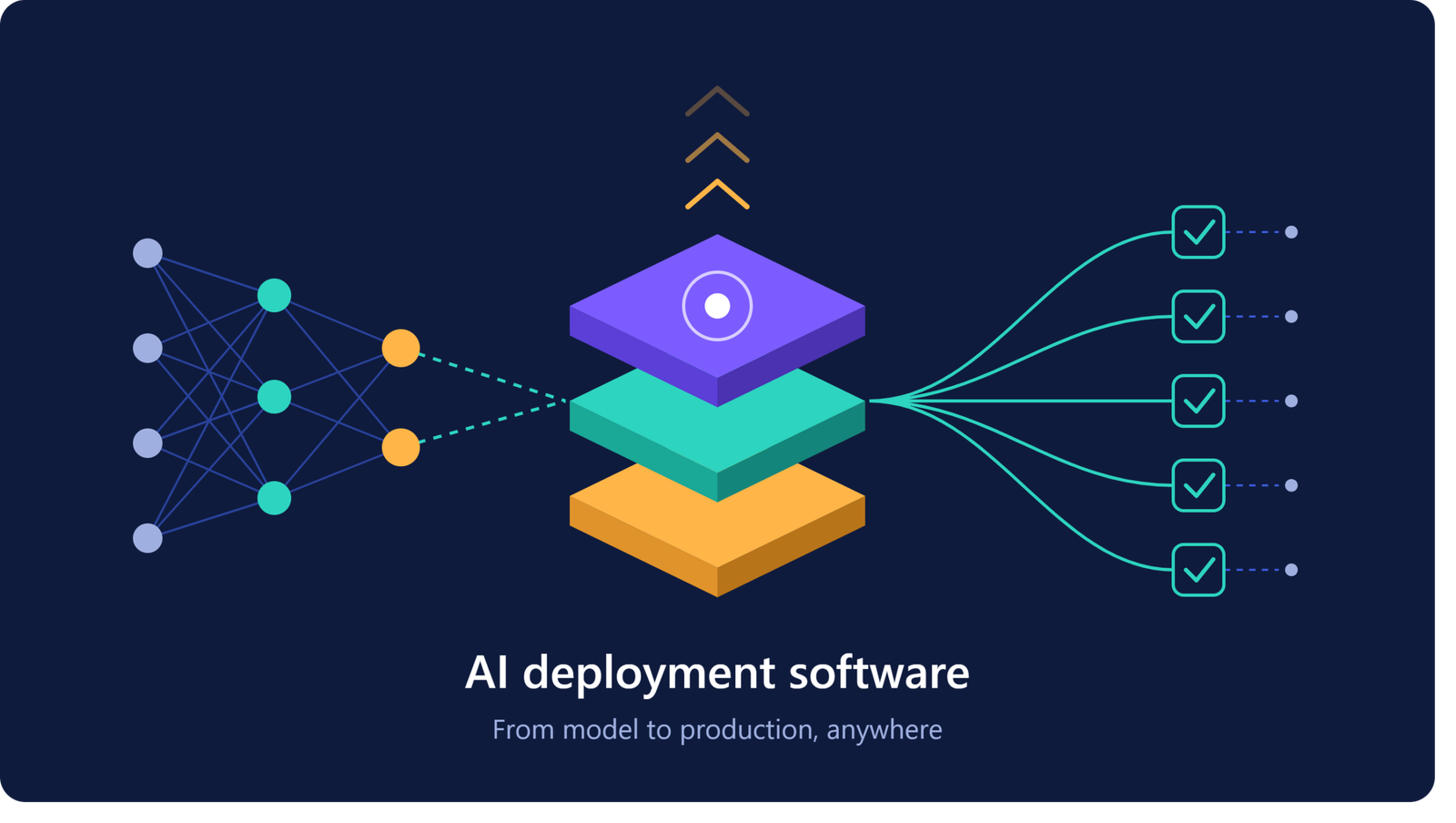
AI deployment software helps organizations move trained AI and machine learning models from development into real-world applications. These platforms simplify model deployment, infrastructure management, monitoring, scaling, and maintenance.
What Is AI Deployment Software?
AI deployment software refers to tools and platforms designed to make it easier to put artificial intelligence models into production. Instead of manually configuring servers, APIs, containers, and monitoring systems, development teams can use deployment software to automate many of these tasks.Ultimate Guide to AI Development Tools
An AI deployment platform can support different types of models, including machine learning models, deep learning systems, natural language processing applications, computer vision models, and generative AI solutions.
The goal is simple: make AI models available to users and business applications in a reliable, secure, and scalable way.
Why AI Model Deployment Matters
A highly accurate model has little business value if it cannot operate efficiently in production.
AI deployment connects the development environment with actual business operations. Once deployed, a model may need to process thousands or millions of requests while maintaining acceptable response times.
Effective deployment software can help organizations:
- Automate model deployment
- Reduce infrastructure complexity
- Scale AI applications
- Monitor model performance
- Manage different model versions
- Improve application reliability
- Reduce deployment time
- Support continuous integration and delivery
For growing companies, these capabilities can make AI projects easier to maintain over the long term.
Key Features of AI Deployment Software
Not every deployment platform offers the same capabilities. However, several features are particularly important when selecting an AI deployment solution.
Automated Model Deployment
Automation reduces the amount of manual work required to move models into production. Developers can connect deployment workflows to code repositories, testing systems, and infrastructure.
When a new model version passes testing, an automated pipeline can deploy it without requiring every step to be performed manually.
Model Version Management
AI models frequently change as developers improve algorithms, update training data, or modify parameters.
Model versioning allows teams to keep track of different releases. If a new model performs poorly, organizations can potentially roll back to an earlier version.
This makes production AI management more controlled and predictable.
Scalability
AI applications can experience significant changes in demand. A customer-service chatbot may receive moderate traffic during normal hours but experience a sudden increase during a marketing campaign.
AI deployment software can support automatic or configurable scaling so additional computing resources become available when demand increases.
API-Based Deployment
Many AI models need to communicate with websites, mobile applications, SaaS platforms, or internal business systems.
Deployment platforms can expose models through APIs, allowing other applications to send data and receive predictions or generated responses.
For example, an e-commerce application could use a deployed recommendation model through an API to generate personalized product suggestions.
AI Deployment in the Cloud
Cloud infrastructure has become an important part of modern AI deployment.
Cloud-based AI deployment platforms can provide computing resources, storage, networking, security controls, and monitoring without requiring companies to maintain all infrastructure themselves.
Organizations can deploy AI applications using virtual machines, containers, managed services, or serverless architectures depending on their requirements.
Cloud deployment is particularly useful for companies that need flexible infrastructure and variable computing capacity.
Container-Based AI Deployment
Containers provide another popular approach to deploying AI models.
A container packages an application together with its dependencies, libraries, and configuration. This can make it easier to move an AI application between development, testing, and production environments.
Container-based deployment can also improve consistency because developers can reduce differences between environments.
For larger AI systems, container orchestration can help manage multiple services and workloads across infrastructure.
Monitoring AI Models After Deployment
Deployment is not the end of the AI lifecycle.
Once a model is running in production, organizations need to monitor its behavior. A model that performed well during testing may produce different results when exposed to real-world data.
Important monitoring metrics can include:
- Response time
- Error rates
- Resource consumption
- Prediction accuracy
- Request volume
- Model drift
- Data quality
- Infrastructure performance
AI monitoring software can help development teams identify problems before they significantly affect users.
Detecting Model Drift
Model drift occurs when the relationship between input data and expected outcomes changes over time.
For example, a fraud detection model trained on older transaction patterns may become less effective as customer behavior changes.
Monitoring systems can identify unusual changes and help teams determine when retraining or model updates may be necessary.
Security and AI Deployment
Security should be considered before deploying an AI model to production.
AI deployment environments can contain sensitive business information, customer data, proprietary models, and application credentials. Strong authentication, access controls, encryption, logging, and secure API management can reduce potential risks.
Organizations should also carefully evaluate how user data is processed and stored, particularly when deploying AI applications that handle confidential information.
Choosing the Right AI Deployment Software
The right solution depends on the organization’s technical requirements and AI workload.
Before selecting an AI deployment platform, consider:
Deployment Environment
Determine whether the organization needs cloud, on-premises, hybrid, or edge deployment.
Integration
Check whether the platform works with existing programming languages, frameworks, databases, APIs, and development tools.
Scalability
Consider both current workload requirements and expected future growth.
Monitoring
Look for tools that provide useful visibility into model and infrastructure performance.
Cost
Evaluate infrastructure expenses, platform pricing, storage, computing requirements, and operational costs rather than focusing only on the initial price.
The Future of AI Deployment
AI deployment is becoming increasingly automated. Modern workflows are moving toward automated testing, continuous model delivery, real-time monitoring, intelligent scaling, and integrated MLOps practices.
Generative AI is also increasing demand for specialized deployment infrastructure. Large language models and AI agents can require significant computing resources, efficient inference systems, and careful monitoring.
As AI becomes integrated into more business applications, deployment software will play an increasingly important role in making these systems reliable and manageable.
Final Thoughts
AI deployment software provides the infrastructure and automation needed to transform AI models into practical production applications. From automated deployment and model versioning to scalability, API integration, monitoring, and security, these platforms address many of the challenges involved in operating AI systems.
For businesses investing in artificial intelligence, successful deployment should be treated as an ongoing process rather than a one-time technical task. A well-designed deployment workflow can help teams maintain reliable AI applications while adapting models and infrastructure as business requirements evolve.