Businesses today are under constant pressure to improve efficiency, reduce operational costs, and deliver better customer experiences. One of the most effective ways to achieve these goals is through AI business process automation. By combining artificial intelligence with workflow automation, organizations can streamline repetitive tasks, improve decision-making, and allow employees to focus on strategic work.
In this guide, we’ll explore practical AI business process automation examples, explain how AI is reshaping business operations, and discuss the benefits of adopting intelligent automation across different industries.
What Is AI Business Process Automation?
AI business process automation (AI BPA) refers to the use of artificial intelligence technologies to automate routine business workflows and decision-based tasks. Unlike traditional automation, which follows predefined rules, AI can analyze data, recognize patterns, understand natural language, and make informed decisions based on real-time information.
Businesses use AI automation to simplify operations, reduce manual effort, and improve accuracy across departments such as marketing, sales, finance, customer support, and human resources.
Why Businesses Are Investing in AI Process Automation
Organizations are rapidly adopting AI-driven automation because it offers measurable improvements in productivity and operational performance.
Some key advantages include:
- Reduced manual workloads
- Faster task completion
- Lower operational costs
- Improved data accuracy
- Better customer experiences
- Smarter business decisions
- Increased employee productivity
- Scalable business operations
These benefits help companies remain competitive in an increasingly digital marketplace.
AI Business Process Automation Examples
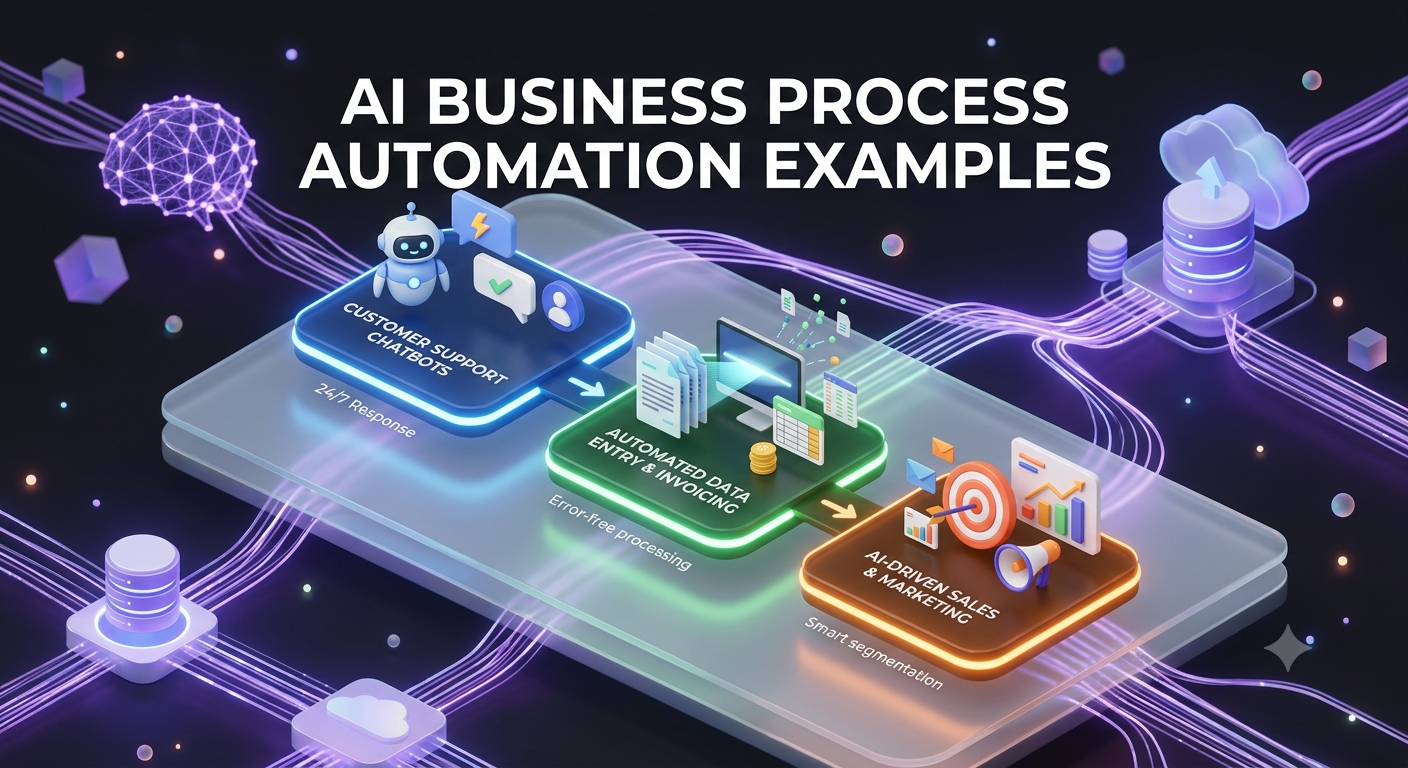
1. Customer Support Automation
Customer service is one of the most common areas where AI automation delivers immediate value.
AI-powered chatbots and virtual assistants can:
- Answer frequently asked questions
- Route customer inquiries to the right department
- Provide order updates
- Resolve simple issues instantly
- Escalate complex requests to human agents
This reduces response times while improving customer satisfaction.
2. Invoice Processing and Accounts Payable
Finance departments often spend significant time handling invoices manually.
AI can automatically:
- Extract invoice data
- Verify purchase orders
- Match payment records
- Detect duplicate invoices
- Approve low-risk payments
- Generate financial reports
This minimizes human error and accelerates payment workflows.
3. Employee Onboarding
Human resources teams can automate onboarding processes using AI.
Typical automated tasks include:
- Collecting employee documents
- Creating user accounts
- Scheduling orientation sessions
- Assigning training materials
- Sending welcome emails
- Tracking onboarding progress
Employees enjoy a smoother experience while HR teams save valuable time.
4. Lead Qualification in Sales
Sales teams receive leads from multiple sources every day.
AI can evaluate incoming leads by analyzing factors such as:
- Customer behavior
- Website activity
- Purchase intent
- Engagement history
- Demographic information
Qualified leads are automatically assigned to sales representatives, increasing conversion opportunities.
5. Email Workflow Automation
AI simplifies business communication by automating email-related tasks.
Examples include:
- Personalized email generation
- Follow-up reminders
- Customer segmentation
- Campaign scheduling
- Email summarization
- Spam filtering
Marketing and sales teams can engage customers more efficiently with less manual effort.
6. Document Management
Organizations handle thousands of documents every year.
AI automation can:
- Classify documents
- Extract key information
- Organize digital files
- Identify duplicates
- Search documents instantly
- Maintain version control
This significantly improves document accessibility and compliance.
7. Inventory Management
Retailers and manufacturers rely on AI to automate inventory operations.
AI systems can:
- Monitor stock levels
- Predict product demand
- Generate purchase orders
- Detect inventory shortages
- Optimize warehouse operations
These capabilities reduce stockouts and improve supply chain efficiency.
8. Marketing Campaign Optimization
AI enables marketing teams to automate campaign management while improving performance.
Automated marketing processes include:
- Audience segmentation
- Content recommendations
- Social media scheduling
- Performance analysis
- Ad optimization
- Customer journey personalization
This helps businesses maximize marketing ROI.
9. Recruitment Automation
Hiring involves numerous repetitive administrative tasks.
AI can automate:
- Resume screening
- Candidate ranking
- Interview scheduling
- Skills matching
- Applicant communication
- Recruitment analytics
Recruiters spend more time evaluating qualified candidates rather than sorting applications manually.
10. Predictive Maintenance
Manufacturing companies use AI to monitor equipment performance continuously.
By analyzing sensor data, AI can:
- Detect abnormal machine behavior
- Predict equipment failures
- Schedule maintenance proactively
- Reduce production downtime
- Extend equipment lifespan
This improves operational reliability while lowering maintenance costs.
Industries Benefiting from AI Business Process Automation
AI automation is transforming businesses across multiple industries.
Healthcare
Healthcare providers automate appointment scheduling, patient record management, medical coding, and administrative documentation while improving operational efficiency.
Banking and Financial Services
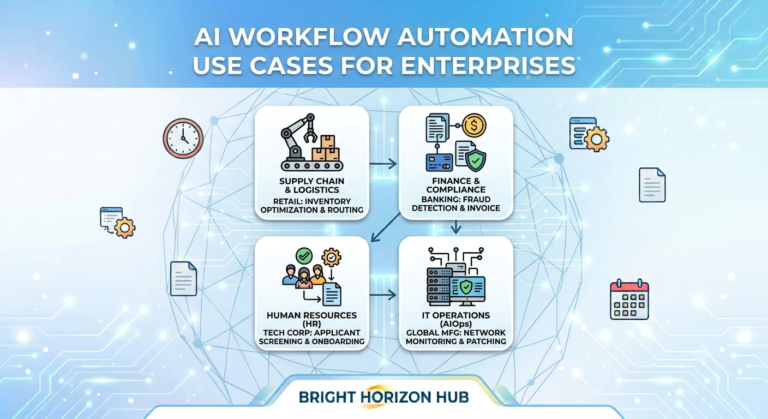
Banks use AI for fraud detection, loan processing, identity verification, customer service, and compliance monitoring.
E-commerce
Online retailers automate order processing, inventory updates, personalized recommendations, customer support, and shipment tracking.
Manufacturing
Manufacturers improve production planning, quality control, predictive maintenance, and supply chain management using AI-powered automation.
Professional Services
Consulting firms, legal practices, and accounting firms automate document preparation, scheduling, contract analysis, and client communication.
Best Practices for Implementing AI Automation
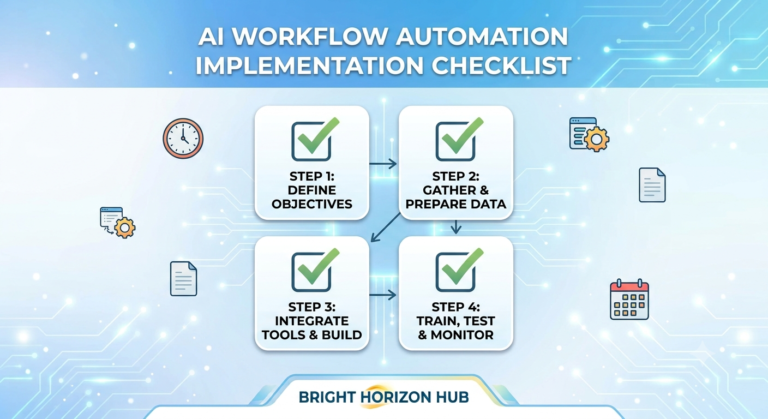
To maximize the success of AI business process automation, organizations should follow several best practices.
Identify Repetitive Processes
Start by automating tasks that consume significant time and require minimal human judgment.
Maintain High-Quality Data
AI performs best when trained on accurate and organized business data.
Integrate Existing Systems
Choose automation platforms that work seamlessly with CRM software, ERP systems, accounting tools, and communication platforms.
Monitor and Improve
Regularly evaluate workflow performance and refine automation processes as business needs evolve.
The Future of AI Business Process Automation
Artificial intelligence continues to evolve rapidly. Future automation platforms will offer more advanced capabilities such as predictive decision-making, autonomous workflows, intelligent document understanding, and conversational AI assistants.
Businesses that embrace AI-powered process automation today will be better prepared to improve efficiency, reduce costs, and adapt to changing market demands in the years ahead.
Conclusion
The growing adoption of AI business process automation is changing how organizations operate across every industry. From customer support and finance to HR, marketing, sales, and manufacturing, AI enables businesses to automate repetitive tasks while improving accuracy, speed, and productivity.
By implementing practical AI business process automation examples, companies can streamline operations, enhance customer experiences, and free employees to focus on innovation and strategic growth. As AI technology advances, intelligent automation will become an essential component of every successful digital transformation strategy.