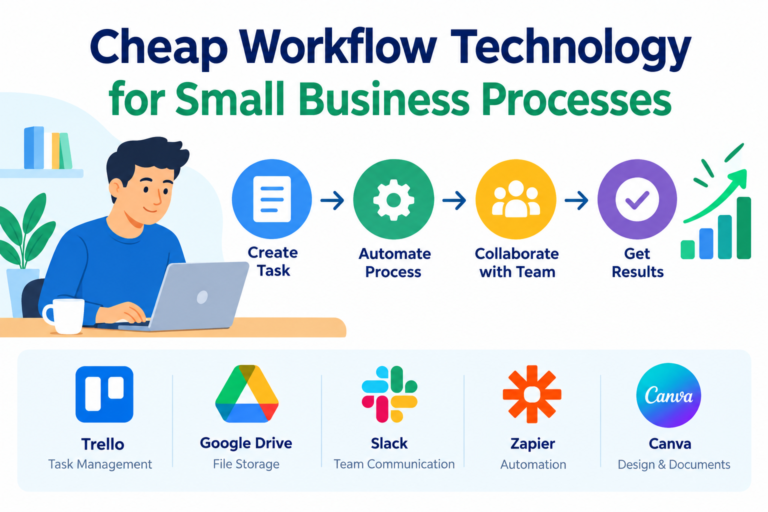

Running a small business often means managing multiple responsibilities at the same time. Owners and employees may handle customer communication, sales, invoices, scheduling, marketing, project management, and internal administration with limited resources.
The right affordable digital tools for small business workflow can make these responsibilities much easier to manage. Instead of investing in complicated enterprise software, small businesses can use practical digital solutions to organize work, automate repetitive processes, and improve team productivity.
The key is choosing tools that solve genuine business problems without creating unnecessary costs or complexity.
Why Digital Workflow Tools Matter for Small Businesses
A business workflow defines how a task moves from beginning to completion. Without a clear system, employees may rely on emails, paper notes, spreadsheets, or messaging apps to keep track of important work.
This can lead to missed deadlines, duplicated tasks, communication problems, and wasted time.
Affordable workflow software provides a central way to organize responsibilities. Businesses can assign tasks, track progress, store information, and automate routine activities.
Even a small improvement in daily efficiency can have a significant impact over an entire year.
Best Affordable Digital Tools for Small Business Workflows
1. Project and Task Management Tools
Project management platforms help businesses organize tasks and responsibilities in one place.
Instead of sending repeated messages asking about project progress, team members can view assigned tasks and deadlines directly.
Useful features include task assignments, due dates, checklists, project boards, notifications, and progress tracking.
A small marketing agency, for example, can create a workflow where every client project moves through stages such as content planning, writing, editing, approval, and publication.
2. Cloud-Based Document Tools
Cloud-based document platforms are essential for businesses that need simple and affordable collaboration.
Employees can create, edit, and share documents without constantly exchanging attachments.
Cloud storage also makes important files accessible from different devices, which is particularly useful for remote or hybrid teams.
Businesses can organize folders for contracts, invoices, client documents, marketing assets, and internal records.
3. Communication and Collaboration Software
Business communication can become disorganized when conversations are spread across personal messaging apps and email threads.
Digital collaboration platforms provide dedicated spaces for team discussions, project updates, and file sharing.
Small businesses can create separate channels or groups for sales, customer support, operations, and marketing.
This helps employees find information faster and reduces unnecessary meetings.
Automating Repetitive Business Processes
One of the biggest benefits of modern small business workflow tools is automation.
Automate Routine Notifications
Businesses can automatically send reminders when tasks are due, invoices are approaching their payment date, or customers complete a specific action.
These small automations reduce the need for employees to remember every follow-up.
Automate Data Entry
Connecting online forms with spreadsheets or customer management systems can eliminate repetitive copying and pasting.
For example, when a potential customer submits a contact form, their information can automatically enter a lead database and trigger a notification for the sales team.
This creates a smoother workflow while reducing manual errors.
Affordable Customer Relationship Management Tools
Customer relationship management, or CRM, software helps businesses organize customer information and sales activities.
An affordable CRM can store contact details, track conversations, record sales opportunities, and schedule follow-ups.
For a small business, this can be much more efficient than maintaining customer information across multiple spreadsheets.
A structured CRM workflow also helps ensure that potential customers do not disappear simply because someone forgot to follow up.
Digital Scheduling and Appointment Management
Manual appointment scheduling can consume a surprising amount of time.
Affordable scheduling tools allow customers to select available times without repeatedly communicating with staff.
Businesses can also automate appointment confirmations and reminders.
This is particularly useful for consultants, service providers, agencies, tutors, repair businesses, and other appointment-based companies.
Online Invoicing and Expense Management
Financial administration is another area where digital tools can improve workflow efficiency.
Online invoicing software can help businesses create invoices, monitor payment status, organize customer billing information, and send reminders.
Expense management tools can also help categorize business spending and simplify financial recordkeeping.
These solutions do not replace professional accounting advice, but they can reduce routine administrative work.
How to Select Affordable Workflow Software
Choosing software simply because it has the lowest price can be a mistake.
The cheapest tool is not always the most cost-effective option.
Look for Essential Features
Before purchasing a platform, identify the specific workflow problem you want to solve.
Consider whether you need:
- Task management
- Team collaboration
- Automation
- Customer management
- Document storage
- Scheduling
- Reporting
- Integration with existing applications
Avoid paying for dozens of advanced features your business will never use.
Check Integration Options
Your digital tools should work together whenever possible.
For example, your scheduling system might need to connect with your calendar, while your website forms may need to connect with your CRM.
Good integration reduces duplicate data entry and makes the overall workflow more efficient.
Consider Scalability
A tool that works for three employees may become difficult to manage when the company reaches 20 employees.
Choose software that can grow with your business without forcing you to migrate everything immediately to another platform.
Common Mistakes to Avoid
Small businesses sometimes purchase too many applications.
Having a separate platform for every task can actually make operations more complicated.
Another mistake is automating a poorly designed process. Automation does not fix a broken workflow; it can simply make the inefficient process happen faster.
Businesses should first simplify their workflow and then automate repetitive steps.
Training is also important. Employees need to understand how and when each tool should be used.
Building a Low-Cost Digital Workflow
A practical approach is to start with the most time-consuming repetitive process.
For example, a business might begin by organizing customer information in a CRM. Next, it could automate follow-up reminders and connect online forms to the customer database.
After that, scheduling, invoicing, reporting, or internal communication can be improved.
This gradual approach keeps technology spending under control while allowing the business to measure the value of every new tool.
Final Thoughts
Affordable digital tools for small business workflow can improve productivity without requiring a large technology budget.
Task management platforms, cloud document systems, communication software, CRM solutions, scheduling tools, invoicing platforms, and workflow automation services can help businesses reduce manual work and maintain better organization.
The smartest strategy is not to collect as many tools as possible. It is to build a simple digital workflow around the actual needs of the business.
Start with one problem, choose a practical solution, measure the results, and expand gradually. With the right approach, affordable technology can turn scattered daily tasks into a more organized, efficient, and scalable business operation.